Working together, we foster stronger test takers and more confident, independent thinkers. Each lesson is an opportunity to develop skills that last beyond test day.
A student starting at 31 on the ACT has only five points left to gain. Getting to 35 means earning four of those five points: 80% of the way from their starting score to a perfect one.
That’s why we also look at how much of the remaining room for improvement a student uses. It helps put the progress of students who start with strong scores into perspective.
AN ACT SCORE EXAMPLE
31Starting score
35Higher score
36Perfect score
4 of 5 available points gained 80% of the gap to a perfect score closed
01 / THE PATEK PREP APPROACH
There’s more to learning than memorizing.
A student can spend an enormous amount of time studying and still feel like they aren’t getting anywhere. I know the feeling; for a long time, memorizing was the only way I knew how to learn.
What changed was learning to look for the principles underneath the subject. That approach now informs how I teach, along with two things that matter just as much: a student’s curiosity, and their relationship with the person teaching them.
Sitting down and taking advice from someone is a surprisingly intimate process. It’s hard to learn from someone you’re not certain has your best interests at heart, and even harder to communicate to them what it is you need.
I work hard to ensure my students feel heard, supported, and comfortable. When it comes time to listen, they know I truly have their back.
02
Curiosity
A lot of students dislike school. Some even believe they dislike the very concept of learning. I love to learn.
From quantum mechanics to music theory, genetic engineering, and obscure cinema, my own curiosity has taken me in plenty of directions. I make room for that in lessons, too—including indulging a student’s line of questioning to the very end of my abilities (and sometimes even well past that).
03
Fundamentals
Most topics are self-consistent, and operate on a shared set of principles. Understanding those principles makes a subject much easier to reason through, without having to memorize every fact separately.
With this approach students naturally become more capable of learning on their own and gain confidence in their abilities. I really could go on about how effective this methodology is, but you get the idea!
SEE THE TEACHING
Here’s what I mean.
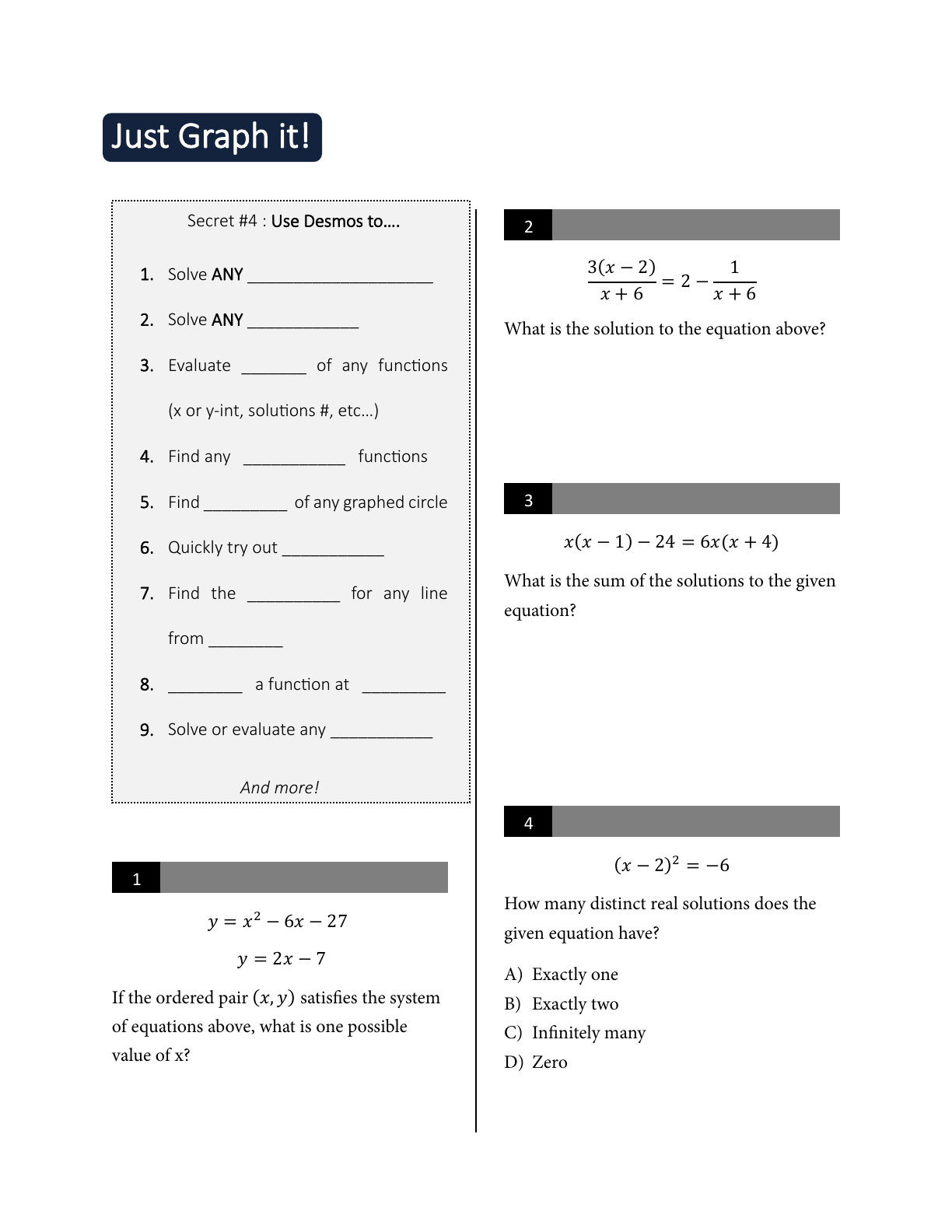
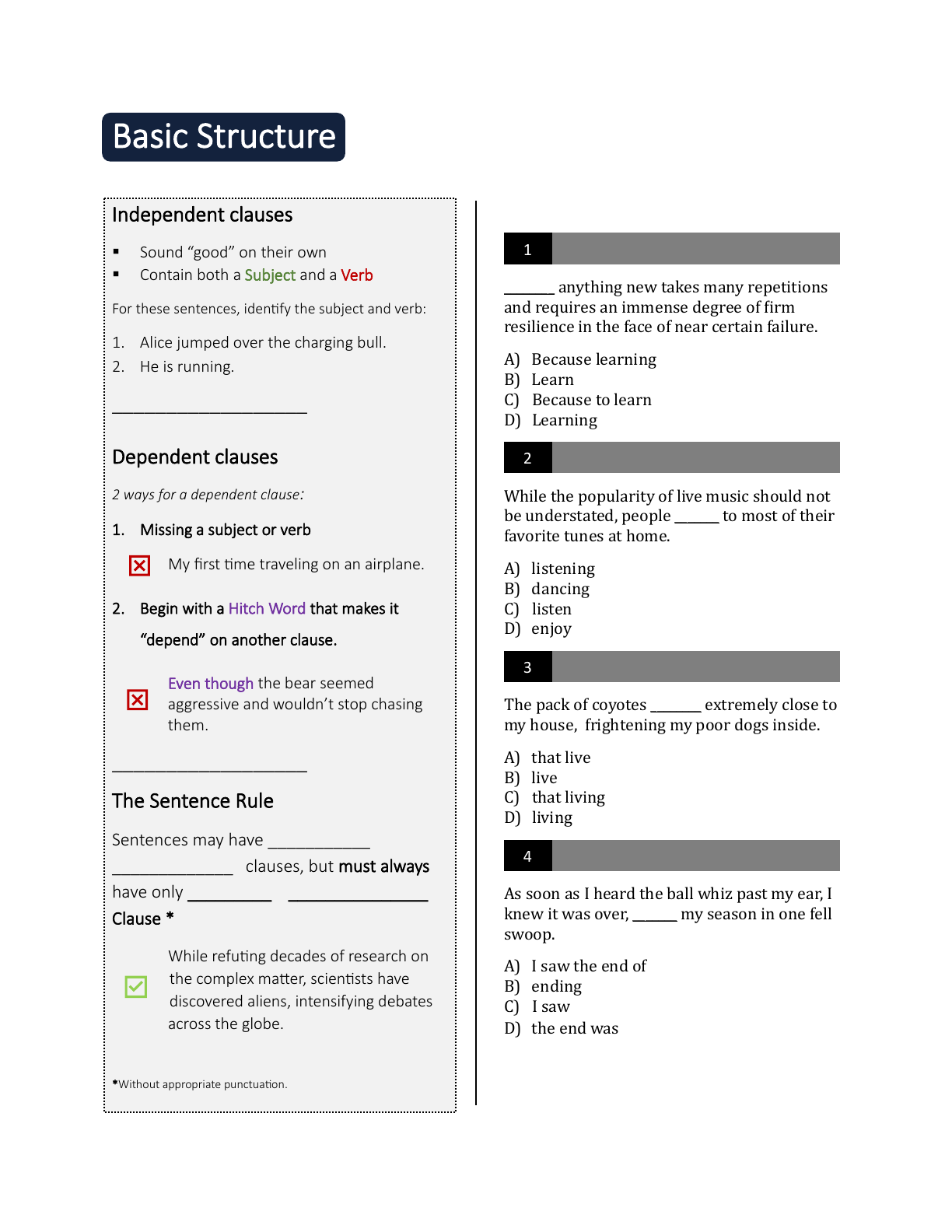
I can tell you about how I teach, but it’s probably more useful to show you. Here’s a clip from a session with a student, along with a couple of pages from my SAT manuals.
These pages are meant to be worked through together. The blanks are there for a reason: there’s a conversation to have before filling them in.
The math page explores what Desmos can do. The grammar page starts with the fundamentals: subjects, verbs, independent and dependent clauses, and what makes a sentence complete.
It’s one of the first questions parents ask, and there’s a good reason for that. The SAT and ACT cover plenty of the same ground, but they ask students to use what they know in different ways.
01DIGITAL SAT
Preparing for the SAT
The SAT tends to test a narrower range of concepts in greater depth, particularly in math. There’s generally more time per question, but quite a bit to think through in that time.
Math questions often ask students to use familiar concepts in unfamiliar ways
Short reading passages can be dense, technical, and drawn from a wide range of subjects
Desmos and a thoughtful choice of method can make a difficult question much more manageable
I often find it a good fit for students who like to think deeply, read closely, and work their way through a complicated idea.
The ACT puts more pressure on breadth and pace. Students need to recognize a wider range of material and keep moving, rather than spend too long untangling any one question.
Math draws on a wide range of concepts, including topics a student may not have seen in a while
Longer reading passages reward efficient reading and keeping track of the larger narrative or argument
Pacing matters: knowing when to move on is part of knowing how to take the test
I often find it suits students who are comfortable with a broad range of concepts and can work through questions at a steady pace.
In three months, Finn raised his ACT score from 29 to 35. He describes preparation that identified the areas he struggled with and made room for the rest of his life.
“He was sociable and created a supportive environment that I felt comfortable in.”
F
Finn TaggartStudent · Google review
★★★★★
AVERY’S STORY34 ACT
Individual questions. Individual attention.
Avery wanted an ACT score that matched her ambitions. One-on-one preparation gave her space to ask questions, strengthen the fundamentals, and build useful study habits.
He was also very communicative with us, which we really appreciated, was always willing to answer any questions, and provided feedback after every session.
C
CJ MParent · Google review
★★★★★
STUDENT ADMISSIONS
A few of the places our students have been admitted.
Harvard University
UC Berkeley
Stanford University
Among others
Princeton University
USC
U.S. Naval Academy
UT Austin
ITAMAR PATEKFounder. Tutor. Lifelong learner.
04 / MEET THE FOUNDER
High expectations with a human approach.
A great tutor should make you feel comfortable asking questions—and excited to find the answers.
Itamar Patek founded Patek Prep around that idea. After studying Molecular Biology & Genetics at UC Berkeley and working in precision oncology, he returned to the work he loves: teaching.
His approach brings together intellectual curiosity, carefully developed materials, and a close understanding of each student. He personally teaches Patek Prep’s students, with the same attention to how they feel about learning as to what they learn.
Outside of tutoring? Music production, filmmaking, writing—and usually something new to be curious about.
UC BERKELEY GRADUATE5+ YEARS OF TEACHING EXPERIENCE
Tutoring is currently provided by Patek Prep founder Itamar Patek. You’ll speak with Itamar during the initial consultation, too.
Do we need to choose SAT or ACT first?+
No. We can discuss your student’s experience, goals, and test timeline, then work out what would be useful to learn before choosing a direction.
Can you help with an already strong score?+
Absolutely. Individual sessions can focus on what is still getting in the way: a particular topic, the interpretation of a question, or a method that takes too long under pressure.
Are sessions online or in person?+
Both. Patek Prep offers both in-person and online tutoring. We’ll discuss the format and meeting arrangements that work for your student.
How much preparation will we need?+
It depends on the starting point, target, test date, and time available for practice. We’ll talk through those pieces and build a plan with room to adjust as your student progresses.
Do you also offer academic tutoring?+
Yes. Selected academic tutoring is available in AP Biology, AP Calculus, and AP Chemistry. Get in touch to discuss your student’s needs and current availability.
GETTING STARTED
Tell me a little about your student.
What are they hoping to accomplish? What have they tried so far? And what’s been giving them trouble? We can start there and work out what would be helpful.
A FREE 15-MINUTE CONSULTATION
Let’s talk about what your student needs.
You’ll speak with me directly. Bring your questions; you don’t need to have the whole process figured out before we talk. The consultation is completely free.